Photo by Gabriel Jimenez on Unsplash
For practitioners
Localisation, donor behaviour, and the redistribution of power
Written by Luuk Springintveld
3 December 2025
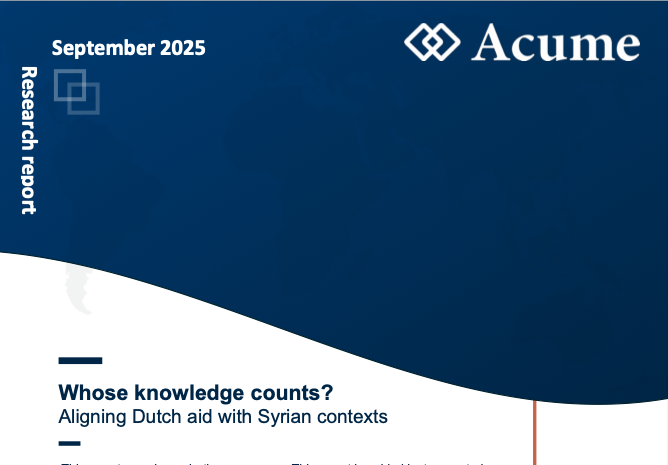
Discussions about power in the humanitarian sector increasingly acknowledge how current practices reflect older colonial structures. Many organisations have committed to addressing these imbalances, yet progress remains uneven.

Two areas repeatedly highlighted in policy debates and research are localisation and donor reform. Both concern how authority, resources, and decision-making are distributed, and both remain central to whether the sector can shift towards more equitable forms of partnership.
Localisation
Localisation is used in many ways across the sector, but in this context it refers to American and European NGOs shifting more power to local and national actors, including greater leadership roles, decision-making authority, and control over resources.
It is presented as one means of addressing entrenched power imbalances and the racial and colonial attitudes that can shape sector decision-making.
The findings emphasise the strengths local actors already bring. They have direct access to affected communities, speak the relevant languages, and hold established trust. These attributes position them as more than recipients and underline the value of collaborating with local organisations to improve relationships, reduce power asymmetries, and increase efficiency.
The research also highlights training and capacity-building as important to localisation. These efforts are described as investments in long-term autonomy, contrasted with funding alone, which is often tied to short-term needs. Strengthening skills and organisational capacity is presented as a way of enabling local organisations and individual actors to respond independently now and in the future.
Donor reform
Donors play a decisive role in shaping the humanitarian system. Their influence extends beyond financing to determining priorities and the overall direction of humanitarian responses. The research identifies funding allocation as a significant point of concern, with resources concentrated in donor countries and large international organisations- often referred to as ‘donor darlings’.
This concentration and ‘favouritism’ means smaller, newer, and local organisations remain underfunded and undervalued. According to the research, this pattern slows progress in addressing power imbalances.
Addressing funding favouritism and ensuring that smaller and local aid organisations receive a fair share of funding is essential for building a more equitable humanitarian world. Yet, the key challenge remains: how can donors be convinced to shift funding toward local organisations?
Donor’s hesitation often stems from a lack of familiarity with smaller organisations and concerns about financial mismanagement or corruption.
A crucial step in overcoming this barrier is for large international NGOs to advocate on behalf of their local partners. However, this will require a willingness on their part to accept reduced funding and to share power.
Building donor confidence is also linked to demonstrating financial competence. The research points to cash-management training programmes as one way of equipping local partners to manage and distribute funds responsibly. These programmes can help increase donor trust while also strengthening local partners’ skills.
Power and resources
Ultimately, funding is power. If the sector aims to address its colonial legacy and move towards more balanced partnerships, local partners need greater access to resources.
The critical question remains: Are donors and large international organisations are prepared to devolve and delegate power, resources, and authority in practice?
Two areas repeatedly highlighted in policy debates and research are localisation and donor reform. Both concern how authority, resources, and decision-making are distributed, and both remain central to whether the sector can shift towards more equitable forms of partnership.
Localisation
Localisation is used in many ways across the sector, but in this context it refers to American and European NGOs shifting more power to local and national actors, including greater leadership roles, decision-making authority, and control over resources.
It is presented as one means of addressing entrenched power imbalances and the racial and colonial attitudes that can shape sector decision-making.
The findings emphasise the strengths local actors already bring. They have direct access to affected communities, speak the relevant languages, and hold established trust. These attributes position them as more than recipients and underline the value of collaborating with local organisations to improve relationships, reduce power asymmetries, and increase efficiency.
The research also highlights training and capacity-building as important to localisation. These efforts are described as investments in long-term autonomy, contrasted with funding alone, which is often tied to short-term needs. Strengthening skills and organisational capacity is presented as a way of enabling local organisations and individual actors to respond independently now and in the future.
Donor reform
Donors play a decisive role in shaping the humanitarian system. Their influence extends beyond financing to determining priorities and the overall direction of humanitarian responses. The research identifies funding allocation as a significant point of concern, with resources concentrated in donor countries and large international organisations- often referred to as ‘donor darlings’.
This concentration and ‘favouritism’ means smaller, newer, and local organisations remain underfunded and undervalued. According to the research, this pattern slows progress in addressing power imbalances.
Addressing funding favouritism and ensuring that smaller and local aid organisations receive a fair share of funding is essential for building a more equitable humanitarian world. Yet, the key challenge remains: how can donors be convinced to shift funding toward local organisations?
Donor’s hesitation often stems from a lack of familiarity with smaller organisations and concerns about financial mismanagement or corruption.
A crucial step in overcoming this barrier is for large international NGOs to advocate on behalf of their local partners. However, this will require a willingness on their part to accept reduced funding and to share power.
Building donor confidence is also linked to demonstrating financial competence. The research points to cash-management training programmes as one way of equipping local partners to manage and distribute funds responsibly. These programmes can help increase donor trust while also strengthening local partners’ skills.
Power and resources
Ultimately, funding is power. If the sector aims to address its colonial legacy and move towards more balanced partnerships, local partners need greater access to resources.
The critical question remains: Are donors and large international organisations are prepared to devolve and delegate power, resources, and authority in practice?
Ground your decisions in local knowledge. Acume connects you to regional experts with lived experience.
See how we help.
Login
Please login to comment
0 Comments
Oldest
Related Stories

For practitioners
Exploring the place of diaspora members and newcomers in humanitarian partnerships
10 December 2025 | Luuk Springintveld
For practitioners
Localisation, donor behaviour, and the redistribution of power
3 December 2025 | Luuk Springintveld

For practitioners
Decolonising humanitarian partnerships: shifting mindsets and sharing power
26 November 2025 | Luuk Springintveld