


Content
About this brief



Ethiopian church forests: a socio-religious conservation model under change
Written by:

Other researchers:
This study investigates church forests in northern Ethiopia. It sheds light on how these dynamic socio-religious spaces preserve these unique surviving pockets of the endemic native forests, but at the same time present a threat to its survival. It contributes to the understanding of the little known interaction between church forest communities and their environment.
Some of the remaining native trees in Ethiopia are forests surrounding churches of the Ethiopian Orthodox Tewahido Church. Although these remming patches of biodiversity have survived for centuries, they face a number of threats as well as new opportunities due to changes in the economic well-being and social practices of the communities that attend those churches and actively use their forest for socioreligious practices.
This study was motivated by the need to better understand the connection between religiously motivated practices that appear to have resulted in the survival of the native trees in this part of Ethiopia.
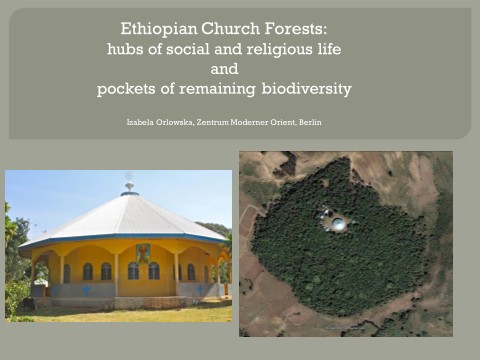
Ethiopian Orthodox church and an aerial photograph of a church surrounded by trees
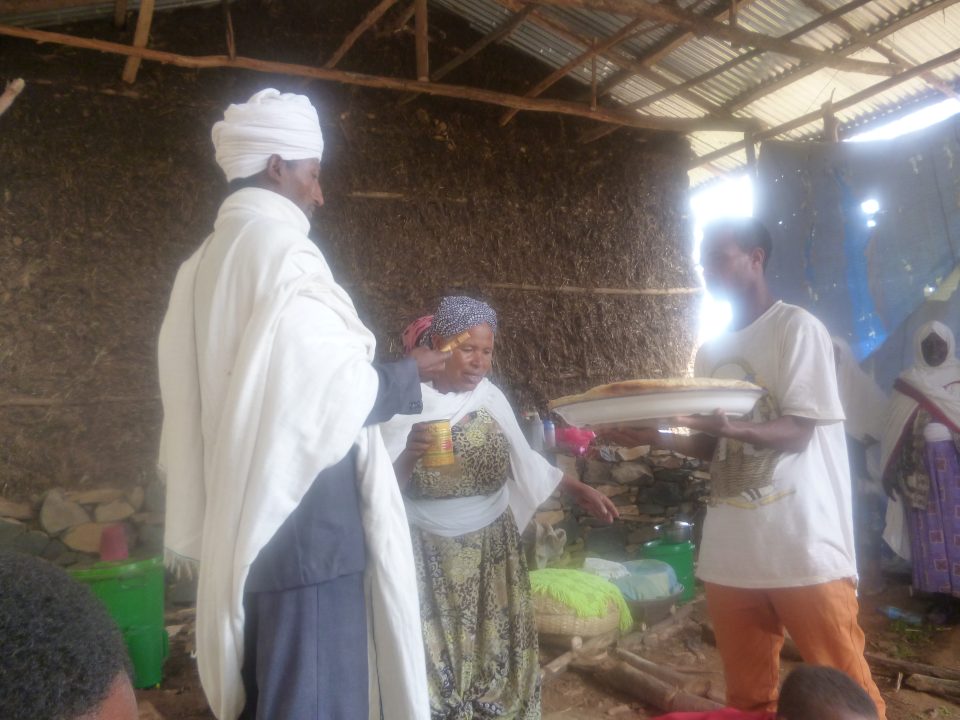
Community meeting, blessing of the bread before the feast
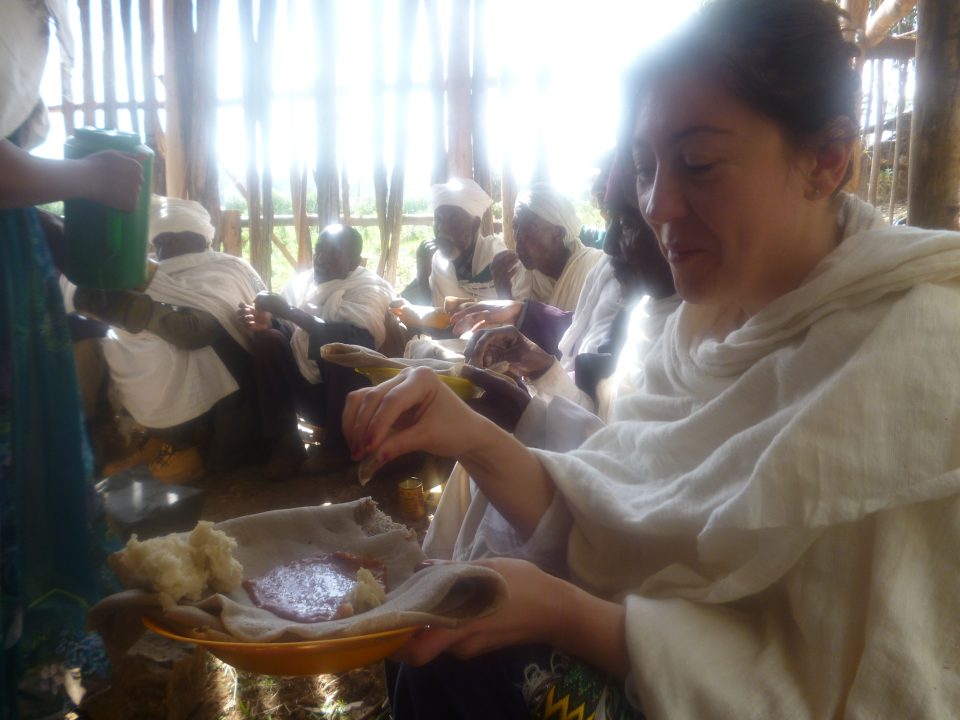
Eating to praise saints and receive blessings, meeting in a built structure in a church forests
Key findings
- Church forests are protected as a direct result of a unique socio-religious conservation model based on traditional belief system of the Ethiopian Tewahdo Orthodox Church that considers church forests extensions of churches, infused with the divine powers radiating from the core of the church. The preservation of these forests is not an active act of ecological preservation.Evidence
Today there are some 8,000 church forests in the Amhara Regional State, located in the highlands of northern Ethiopia. In a 30,000 km2 section of the South Gondar Zone, located in the geographic center of the State, church forests have an average size of around 5 ha.13 While only four out of 1,022 church forests disappeared from within this swath between 1962 and 2012, suggesting stability in ecological conditions, there was an average 16.9% decrease in crown closure over the same time period and signs of significant human disturbance (e.g. trails, gravestones, structures, gathering areas, planted exotic tree species, and weedy taxa) are plentiful in a representative sample of 29 church forests. In addition, in the 1930s there was a buffer of bushland between the church forest edge and surrounding agricultural and grazing land, which has since dis- appeared and that may threaten the ecological integrity of the church forest.
What it meansThis new and a key funding sets Ethiopian church forests apart from other natural sacred place, where often the trees or other natural landmarks are believed to have supernatural qualities. The evidence suggest that church forests are not in acute danger as the existing tradition model seems to have preserved the forests quite well, but there is evidence of change and an increase of new practices (such as eucalyptus planting) that might threaten church forest in the near future.
- Church forest communities have preserved core religious ideas allowing forest protection throughout their historyEvidence
Church forest grounds are used regularly and in specific ways by the congregation,whose members organise themselves into associations (mehabirs) affiliated with a particu- lar saint. Mehabir members meet within the forest to celebrate a chosen patron saint and to commemorate them by feasting together. Feeding others and providing drink is seen as a way to worship saints and help the dead in their arduous journey to heaven.
What it meansthis suggest durability and strength of the existing interaction between church forests communities and they environment.
Research on commensality (eating and drink- ing together) shows that it is a catalyst for other forms of cooperation and strengthens social capital, which is consistent with our argument that church forests help foster social capital in the community.church forests are places where the social and the spiritual merge, which creates an environment conducive to strong social capital. They are places of interaction with neighbours, saints, and secular authorities and form the central place for local communities.
- Eucalyptus planting has divers impact on both the church forest cover and the local economyEvidence
Many interviewees reported that growing eucalyptus has great improved their economic situation.
What it meansEucalyptus is increasingly being used as a means to financially support the communities but as a plant is very harmful for preservation of biodiversity. On the other hand, urban migration has brought in new financial resources that are invested in new buildings which can also lead to deforestation.
- Despite the strong belief that church forests are considered extension of churches, enforcement of sanctions by communities is weak.Evidence
The indigenous model of church forest protection is based mainly on the existence of religious values and is largely an informal practice.
What it meansthe punishment for trespassers are wrong doers is left mainly to the dive powers and is not strictly implemented, which strongly suggests religious connotation of the system, rather than community protection model found elsewhere.
- The preservation of church forests by local communities is based on religious belief that continues to be strong, however there are noticeable generational differences.Evidence
Young people are less likely to care about the divine dimension of the forest, while they are still likely to care about the church as a socioreligious spaces.
What it meansThis suggest that the most important aspect in the preservation model is the is the role of the forest as a gathering place for the congregation.
- National and international narratives about forest protection – grounded in concerns about cultural heritage, ecosystem services, and land productivity – are introducing new stakeholders to church forest protection. These include: NGOs and the scientific community as well as the Ethiopian government and the upper echelons of the EOTC.Evidence
There has been initiative of building stone walls around church forests parameter intended to prevent cattle entering forests. However, several interviews confirm that church authorities like to have a wall as a marker of prestige rather than a real need.
What it meansThis suggest that it is important to understand the sociocultural dynamic on the ground before introducing solutions.
- There is a difference in importance attached to natural forest, the so-called wof zerash, or weled, compare to planned forests.Evidence
The actual role of birds in the creation of church forest is unclear, however, older
priests explain the difference in importance between the naturally growing native trees and the forests planted from exotic species.
McCann notes: “Christopher Clapham36 astutely observed that the species of endemic birds that evolved on the highlands are ground-dwelling, indicating a long period of open savanna habitat.”37
What it meansThis suggested that planned forests is considered less valuable.
Proposed action
- Cooperation between local stakeholders and external actors
Research combining ecology with the socio-cultural and economic context is aproductive direction to take
It has to be understood how the forest is being used by the communities and through which practices and traditions they relate to the forest.
- External interventions should be carefully considered. If they do not integrate the ways in which the communities relate to their environment, they unlikely to work.
Close cooperations between all stakeholders.
Despite the emerging challenges, there is the potential for adaptations to the forest protection model. The new model may draw on existing narratives within the church related to nature and society relationships as well as communities’ demonstrated willingness to engage with external agents, who have recently grown in importance. The relatively “closed” church forest communities are now cultivating ties with entities outside of the community that have political and financial power and this development can be build upon. While connections between divinity and nature do not come easily to ordinary people’s minds, they are present in Ethiopian Orthodox tradition and present an opportunity for those who want to cultivate environmental values in rural Ethiopia.
Comments
You must log in to ask a question
Acknowledgements
Special thanks to Caroline Rohr for preparation assistance
We would like to extend a special thank you to Caroline Rohr, for their invaluable contribution in assisting the preparation of this research summary.
Are you a researcher looking to make a real-world impact? Join Acume and transform your research into a practical summary.
Already have an account? Log in
Discover more
Ethiopian church forests: a socio-religious conservation model under change
Cite this brief: Orlowska, Izabela. 'Ethiopian church forests: a socio-religious conservation model under change'. Acume. https://www.acume.org/r/ethiopian-church-forests-a-socio-religious-conservation-model-under-change/
Brief created by: Dr Izabela Orlowska | Year brief made: 2023
Original research:
- Klepeis, P., & Orlowska, I., ‘Ethiopian church forests: a socio-religious conservation model under change’ 12(4), pp. 674–695 https://doi.org/10.1080/17531055.2018.1519659. – https://doi.org/10.1080/17531055.2018.1519659
- Klepeis, P., & Orlowska, I., ‘Ethiopian Church Forests: A Hybrid Model of Protection’ 44, pp. 715–730 https://doi.org/10.1007/s10745-016-9868-z. – https://link.springer.com/article/10.1007/s10745-016-9868-z
Research brief:
This study investigates church forests in northern Ethiopia. It sheds light on how these dynamic socio-religious spaces preserve these unique surviving pockets of the endemic native forests, but at the same time present a threat to its survival. It contributes to the understanding of the little known interaction between church forest communities and their environment.
Some of the remaining native trees in Ethiopia are forests surrounding churches of the Ethiopian Orthodox Tewahido Church. Although these remming patches of biodiversity have survived for centuries, they face a number of threats as well as new opportunities due to changes in the economic well-being and social practices of the communities that attend those churches and actively use their forest for socioreligious practices.
This study was motivated by the need to better understand the connection between religiously motivated practices that appear to have resulted in the survival of the native trees in this part of Ethiopia.
Findings:
Church forests are protected as a direct result of a unique socio-religious conservation model based on traditional belief system of the Ethiopian Tewahdo Orthodox Church that considers church forests extensions of churches, infused with the divine powers radiating from the core of the church. The preservation of these forests is not an active act of ecological preservation.
Today there are some 8,000 church forests in the Amhara Regional State, located in the highlands of northern Ethiopia. In a 30,000 km2 section of the South Gondar Zone, located in the geographic center of the State, church forests have an average size of around 5 ha.13 While only four out of 1,022 church forests disappeared from within this swath between 1962 and 2012, suggesting stability in ecological conditions, there was an average 16.9% decrease in crown closure over the same time period and signs of significant human disturbance (e.g. trails, gravestones, structures, gathering areas, planted exotic tree species, and weedy taxa) are plentiful in a representative sample of 29 church forests. In addition, in the 1930s there was a buffer of bushland between the church forest edge and surrounding agricultural and grazing land, which has since dis- appeared and that may threaten the ecological integrity of the church forest.
This new and a key funding sets Ethiopian church forests apart from other natural sacred place, where often the trees or other natural landmarks are believed to have supernatural qualities. The evidence suggest that church forests are not in acute danger as the existing tradition model seems to have preserved the forests quite well, but there is evidence of change and an increase of new practices (such as eucalyptus planting) that might threaten church forest in the near future.
Church forest communities have preserved core religious ideas allowing forest protection throughout their history
Church forest grounds are used regularly and in specific ways by the congregation,whose members organise themselves into associations (mehabirs) affiliated with a particu- lar saint. Mehabir members meet within the forest to celebrate a chosen patron saint and to commemorate them by feasting together. Feeding others and providing drink is seen as a way to worship saints and help the dead in their arduous journey to heaven.
this suggest durability and strength of the existing interaction between church forests communities and they environment.
Research on commensality (eating and drink- ing together) shows that it is a catalyst for other forms of cooperation and strengthens social capital, which is consistent with our argument that church forests help foster social capital in the community.church forests are places where the social and the spiritual merge, which creates an environment conducive to strong social capital. They are places of interaction with neighbours, saints, and secular authorities and form the central place for local communities.
Eucalyptus planting has divers impact on both the church forest cover and the local economy
Many interviewees reported that growing eucalyptus has great improved their economic situation.
Eucalyptus is increasingly being used as a means to financially support the communities but as a plant is very harmful for preservation of biodiversity. On the other hand, urban migration has brought in new financial resources that are invested in new buildings which can also lead to deforestation.
Despite the strong belief that church forests are considered extension of churches, enforcement of sanctions by communities is weak.
The indigenous model of church forest protection is based mainly on the existence of religious values and is largely an informal practice.
the punishment for trespassers are wrong doers is left mainly to the dive powers and is not strictly implemented, which strongly suggests religious connotation of the system, rather than community protection model found elsewhere.
The preservation of church forests by local communities is based on religious belief that continues to be strong, however there are noticeable generational differences.
Young people are less likely to care about the divine dimension of the forest, while they are still likely to care about the church as a socioreligious spaces.
This suggest that the most important aspect in the preservation model is the is the role of the forest as a gathering place for the congregation.
National and international narratives about forest protection – grounded in concerns about cultural heritage, ecosystem services, and land productivity – are introducing new stakeholders to church forest protection. These include: NGOs and the scientific community as well as the Ethiopian government and the upper echelons of the EOTC.
There has been initiative of building stone walls around church forests parameter intended to prevent cattle entering forests. However, several interviews confirm that church authorities like to have a wall as a marker of prestige rather than a real need.
This suggest that it is important to understand the sociocultural dynamic on the ground before introducing solutions.
There is a difference in importance attached to natural forest, the so-called wof zerash, or weled, compare to planned forests.
The actual role of birds in the creation of church forest is unclear, however, older
priests explain the difference in importance between the naturally growing native trees and the forests planted from exotic species.
McCann notes: “Christopher Clapham36 astutely observed that the species of endemic birds that evolved on the highlands are ground-dwelling, indicating a long period of open savanna habitat.”37
This suggested that planned forests is considered less valuable.
Advice:
Cooperation between local stakeholders and external actors
- It has to be understood how the forest is being used by the communities and through which practices and traditions they relate to the forest.
External interventions should be carefully considered. If they do not integrate the ways in which the communities relate to their environment, they unlikely to work.
- Despite the emerging challenges, there is the potential for adaptations to the forest protection model. The new model may draw on existing narratives within the church related to nature and society relationships as well as communities’ demonstrated willingness to engage with external agents, who have recently grown in importance. The relatively “closed” church forest communities are now cultivating ties with entities outside of the community that have political and financial power and this development can be build upon.
While connections between divinity and nature do not come easily to ordinary people’s minds, they are present in Ethiopian Orthodox tradition and present an opportunity for those who want to cultivate environmental values in rural Ethiopia.
- Despite the emerging challenges, there is the potential for adaptations to the forest protection model. The new model may draw on existing narratives within the church related to nature and society relationships as well as communities’ demonstrated willingness to engage with external agents, who have recently grown in importance. The relatively “closed” church forest communities are now cultivating ties with entities outside of the community that have political and financial power and this development can be build upon.